
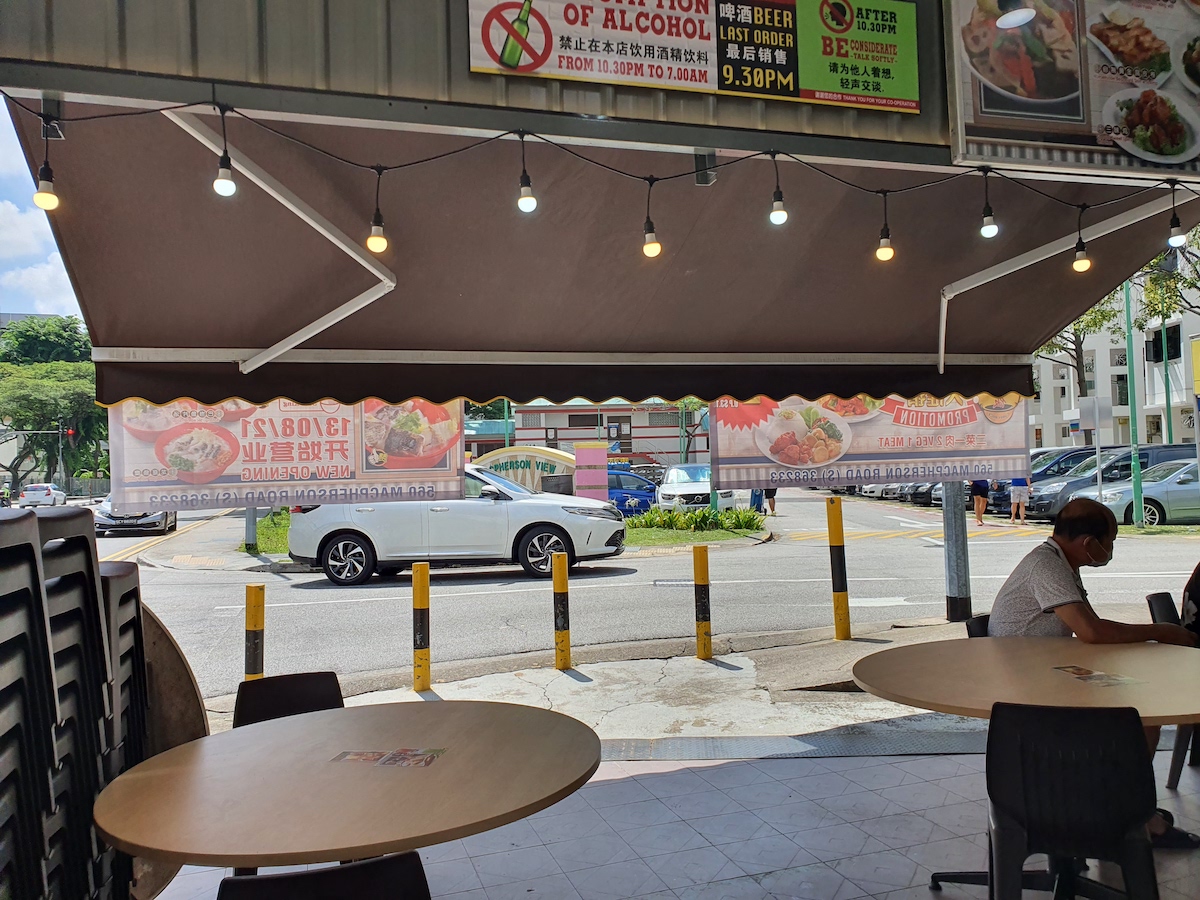
Installing an awning in Singapore usually takes 4 to 7 weeks from signed quotation to working unit. The physical installation takes 2 to 3 hours. The rest is paperwork: 2 to 4 weeks of regulatory approvals and 3 to 4 weeks of fabrication upon confirmation. Depending on property type, an install may need approvals from up to four separate bodies. HDB town council, MCST (for condos), URA (for landed homes and some facade changes), BCA (for structural submissions), and SCDF (for enclosed balconies or installs that affect fire-egress paths). This guide covers what each body requires, what it costs, how long it takes, and where projects typically stall.
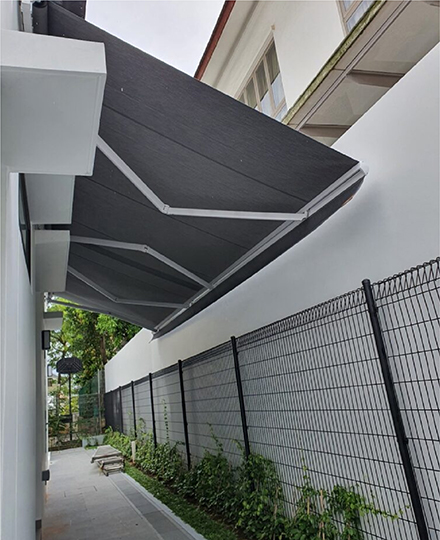
Why awnings are regulated in Singapore
An awning is a structural attachment to an external wall in a country with tropical wind loads, high-density housing, and facades governed by Urban Redevelopment Authority (URA) guidelines. Three layers of regulation apply:
- Building Maintenance and Strata Management Act (BMSMA). Gives the MCST of a strata-titled property statutory authority to approve or reject any installation affecting common property, structural integrity, or the external facade of the development.
- Housing & Development Board (HDB) guidelines. Govern any external alteration to HDB flats, including awnings on balconies, corridors, ground-floor patios, and recess areas. Enforcement is through the town council.
- URA Planning Act. Controls external elevations on landed properties and defines permitted setbacks, gross floor area (GFA) inclusions, and facade material guidelines.
A badly mounted awning can shed in a 50 km/h gust, drain water onto the unit below, or visibly change a block facade. The regulatory layers exist to prevent each of those outcomes. Enforcement is active: HDB town councils conduct periodic inspections and can issue removal orders for unapproved installations.
Approval routes by property type
HDB flats
HDB flats have the most layered approval process because three bodies can be involved: HDB, the town council, and in some cases SCDF.
An awning installed on an open-to-sky balcony in a topmost HDB unit, on the recess area outside an older resale flat, on a ground-floor patio or garden, or extending beyond the unit’s boundary needs town council approval. The application must be filed through a contractor listed in the HDB Directory of Renovation Contractors. The owner cannot submit directly.
- Application document: HDB or Town Council awning permit form (example: Tampines Town Council’s APPLICATION FOR PERMIT TO INSTALL AWNING SECTION II).
- Required attachments: technical drawing showing mounting details, site plan, contractor’s HDB registration number, and wind-load specification.
- Typical approval time: 2 to 4 weeks from complete submission.
- Typical fee: no direct HDB fee when submitted through a registered contractor. Town council may charge an administrative fee of SGD 30 to 100.
- Inspection: some town councils inspect post-installation. Approval must be posted at the worksite during installation.
Interaction balconies (a design feature in newer HDB blocks like those in Punggol, Tampines North, and Bidadari) trigger an additional SCDF fire safety submission if the awning encloses part of the balcony or affects fire-egress paths. A Qualified Person (QP) for Civil or Structural works under the Professional Engineers Act submits a building plan to SCDF. HDB then grants the renovation permit only after SCDF clearance is in hand. Additional time: typically 3 to 6 weeks.
Condominiums and private apartments
Strata-titled developments run through the MCST under the BMSMA. Two approval layers usually apply.
- MCST renovation approval. The owner submits the awning design, technical drawings, fabric and frame specifications, and contractor credentials to the managing agent. The MCST Council reviews against the building’s house rules and by-laws, particularly those covering facade uniformity, colour restrictions, and maximum protrusion.
- URA approval (where applicable). Required if the awning affects the external elevation visible from the street or common areas, or if it extends beyond the approved building envelope. Fee: SGD 220 to 800 depending on submission class.
Most MCSTs require a renovation deposit of SGD 500 to 2,000, refundable on post-works inspection. Turnaround runs 5 to 10 working days for straightforward retractable awnings, 3 to 6 weeks for fixed awnings or those with facade changes that need further review. A BCA-registered Qualified Person is required for any fixed structural awning that transfers load to the building structure beyond standard anchor points.
Landed properties
Landed homes bypass MCST but trigger direct URA and BCA jurisdiction.
- URA planning permission. Required for any awning that alters the external elevation or affects setback-to-boundary distances. Minor additions may qualify for URA’s simplified submission. Major additions require a full submission by a Qualified Person architect or engineer. Fee: SGD 220 (minor works) to SGD 2,200 or more (major addition).
- BCA approval for structural works. A Professional Engineer produces and submits the structural drawings including anchor specifications and wind-load calculations based on Singapore Standard SS EN 1991-1-4 (the local annex of the Eurocode wind action standard).
- Typical fees for PE or QP engagement: SGD 1,500 to 4,500 for drawings and submission.
- Total approval time: 4 to 8 weeks.
Landed property owners should also check whether the home sits within a conservation area (Blair Plain, Joo Chiat, Emerald Hill, and similar). Conservation guidelines add restrictions on awning colour, frame material, and projection profile.
Permit timelines summarised
| Property type | Approvals required | Typical approval time | Typical fees (SGD) |
| HDB flat (simple balcony) | Town council (via registered contractor) | 2 to 4 weeks | 0 to 100 |
| HDB flat (interaction balcony with enclosure) | Town council + SCDF (via QP) | 5 to 10 weeks | 800 to 2,500 |
| Condo (retractable, no facade change) | MCST only | 2 to 3 weeks | 500 to 2,000 deposit (refundable) |
| Condo (facade-affecting awning) | MCST + URA | 4 to 8 weeks | 1,000 to 3,500 |
| Landed (minor retractable) | URA minor works | 3 to 6 weeks | 220 to 2,000 |
| Landed (major fixed or structural) | URA + BCA (via QP) | 6 to 12 weeks | 2,500 to 6,500 |
End-to-end project timeline
The physical install is the fastest part. Everything else is queuing.
| Stage | Typical duration | What happens |
| 1. Site survey | 30 to 90 minutes | Installer measures opening, checks wall substrate, confirms power access, photographs site, documents obstructions. |
| 2. Quote and contract | 3 to 7 days | Line-item quote produced. Owner signs and pays deposit (typically 30 to 50%). |
| 3. Technical drawings | 3 to 10 days | Drawings produced for permit submission including anchor spec, wind-load calc, and facade elevation. |
| 4. Permit submission and approval | 2 to 8 weeks | HDB, MCST, URA, BCA, or SCDF as applicable. |
| 5. Fabrication | 3 to 4 weeks upon confirmation | Made-to-measure cassette and fabric fabricated in workshop. Motor and sensors pre-tested. |
| 6. On-site installation | 2 hours to 1 day | Retractable awnings: 2 to 3 hours. Large pergolas or fixed structural awnings: half to full day. |
| 7. Commissioning and handover | 30 to 60 minutes | Wind sensor calibrated. Rain sensor tested. Smart home pairing completed. Owner briefed on operation and maintenance. |
Realistic total, from signed quotation to awning in use: 4 to 7 weeks for a standard HDB or condo retractable project. Landed installs requiring URA and BCA review routinely run 8 to 12 weeks.
What a compliant installation actually requires
Wall substrate assessment
The installer checks whether the mounting wall is reinforced concrete (the preferred substrate), hollow masonry block, lightweight partition, or aerated concrete panel (common in some newer HDB flats). Mounting method changes based on substrate:
- Reinforced concrete. M10 or M12 chemical anchors (for example Hilti HIT-HY 200, Fischer FIS V). Typical pull-out capacity 15 to 25 kN per anchor.
- Hollow masonry. Through-bolt anchors with a backing plate, or a full-height steel reinforcement strip.
- Lightweight block. Usually needs a steel sub-frame bolted through to internal reinforcement. Adds SGD 800 to 2,000 to the job.
- Aerated concrete. Specialist anchors like Fischer FTP K chemical capsules rated for AAC substrate.
Wind load calculation
Under Singapore Standard SS EN 1991-1-4 (National Annex), basic wind velocity for Singapore is 20 m/s (72 km/h), with peak velocity pressure calculated based on terrain category and height above ground. A standard 4 metre by 3 metre retractable awning mounted at 10 metres above ground in Terrain Category II generates an anchor load of roughly 2.2 to 2.8 kN per fixing point when fully extended in a Class 3 wind event.
The structural drawing submitted with the permit application should show:
- Anchor type, diameter, and embedment depth
- Pull-out and shear capacity of each anchor
- Factor of safety (typically 3.0 or higher)
- Wind load classification under EN 13561
- Total load transmitted to wall at full extension under design wind
Motor, sensor, and electrical work
A licensed electrical worker (LEW) must do the electrical connection for motorised systems. The circuit is typically rated 5 A at 230 V with a weatherproof IP66 junction box at the mounting point. Quality tubular motors ship with a 1.5 metre tail cable terminating in a 3-pin plug or hardwire connection depending on installer preference.
For sensor-equipped systems, the wind sensor mounts on the awning’s front bar or the building facade within 1 metre of the extended position. Rain sensors mount on an unobstructed horizontal or near-horizontal surface. Both use solar or battery power and pair wirelessly to the motor controller.
Common reasons applications get rejected
Five patterns account for most rejected or delayed awning applications in Singapore.
- Submitting through an unregistered contractor. HDB rejects outright. Most MCSTs refuse to open the file. Fix: confirm the contractor’s HDB Directory registration number before paying the deposit.
- Missing wind-load calculations. Reviewers send the application back for revision, adding 1 to 3 weeks. Fix: insist that the technical drawing includes anchor specification and wind-load rating before submission.
- Facade non-conformity. MCST by-laws often prescribe frame colour (usually white or matching the block scheme) and maximum projection. Fix: pull the building’s renovation by-laws from the MA before specifying the awning.
- Protrusion past the unit boundary. HDB flats cannot have awnings that extend into common corridors or over the unit below. Fix: measure projection against the unit line, not just the wall-to-wall balcony width.
- Neighbour objection during MCST circulation. Some MCSTs circulate awning plans to adjacent units for comment. A single objection about view obstruction or facade uniformity can trigger a redesign. Fix: discuss with neighbours before filing.
Cost summary: approvals and compliance
| Cost line | Typical range (SGD) | Who pays |
| HDB town council permit fee | 0 to 100 | Owner |
| MCST renovation deposit | 500 to 2,000 (refundable) | Owner |
| URA submission fee | 220 to 2,200 | Owner |
| SCDF fire safety submission fee | 300 to 1,500 | Owner (via QP) |
| Qualified Person drawings (where required) | 1,500 to 4,500 | Owner |
| BCA Professional Engineer calcs | 800 to 2,500 | Owner |
| Licensed Electrical Worker (motor wiring) | 500 to 1,500 | Usually bundled with installer |
| Contractor admin and coordination | 300 to 800 | Usually bundled with installer |
Working with Smart Awning
Smart Awning handles the full installation chain for Singapore homeowners: site survey with wall substrate testing, technical drawings including wind-load calculations, submission coordination with HDB town councils, MCSTs, URA, BCA, and SCDF where required, fabrication of made-to-measure retractable awnings and louvre pergolas, licensed electrical work, and on-site installation with sensor commissioning. Every quote includes a line-item breakdown of permit fees, QP engagement (where applicable), and fabrication, so the full project cost is visible before contract signing.
Frequently asked questions
How long is the installation time, and what permits are required for awnings in Singapore?
Total timeline from signed quotation to a working awning is 4 to 7 weeks for HDB and condo installations, and 6 to 12 weeks for landed properties. This breaks down into 2 to 8 weeks for permit approval, 3 to 4 weeks for fabrication upon confirmation, and 2 hours to 1 day for on-site installation. Permits needed depend on property type: HDB needs town council approval filed through a registered contractor, condos need MCST approval and sometimes URA, landed homes need URA and often BCA Qualified Person structural submission. SCDF approval is triggered for enclosed balconies or installations affecting fire-egress paths.
Do I need a permit for a retractable awning in Singapore?
Yes. Every awning installation in Singapore requires approval from at least one regulatory body regardless of whether it is retractable or fixed. HDB flat owners need town council approval. Strata property owners need MCST approval. Landed property owners need URA approval, and BCA involvement when the awning is structurally fixed. Retractable awnings are easier to approve than fixed awnings because they do not permanently alter the facade, but the permit is still required.
What happens if I install an awning without approval?
HDB town councils issue rectification orders requiring removal within a stated period, typically 14 to 30 days. Failure to comply leads to enforcement action including fines under the Housing and Development Act. MCSTs can impose daily fines under by-laws and require removal at the owner’s cost. URA enforcement includes enforcement notices and potential criminal charges under the Planning Act for unauthorised works on landed properties.
Can I install an awning on my HDB flat’s balcony?
Yes, subject to town council approval and HDB guidelines. The installation must be through a contractor listed in the HDB Directory of Renovation Contractors, must not extend beyond the unit’s boundary, and must not obstruct common corridors. For interaction balconies, additional SCDF approval is required if the awning affects enclosure or fire-egress paths. The town council permit is usually issued within 2 to 4 weeks of a complete submission.
Can I install an awning outside my condo patio?
Yes, subject to MCST approval under the BMSMA. The MCST reviews the proposed awning against the building’s house rules, facade uniformity standards, and maximum protrusion allowances. Most approvals are issued within 2 to 3 weeks. Where the awning affects the external elevation visible from the street or common areas, URA approval is also required in parallel.
What size awning fits a 3-room HDB balcony?
A standard 3-room HDB balcony is 2.4 to 3.0 metres wide and 1.0 to 1.5 metres deep. A retractable awning with a 2.5 to 3.0 metre width and 2.0 to 2.5 metre projection covers the usable area with a small buffer. Final sizing depends on the mounting wall length, service ledge clearance, and the town council’s rules on protrusion beyond the unit boundary. Oversizing beyond the wall mounting points adds cost without adding covered area.
Who pays for the QP drawings?
The homeowner. Qualified Person (QP) drawings are a regulatory cost, not a hardware cost, and installers do not usually absorb them in the quote. For HDB retractable awnings, QP involvement is rare. The contractor’s standard drawings are typically accepted. QP engagement becomes necessary for structural fixed awnings, large condo installations affecting common property, and most landed-home projects.
Before you start
Awning installation in Singapore goes smoothly when the paperwork runs ahead of the fabrication order. Confirm the property type first, get the site survey scheduled, verify the contractor’s HDB registration before paying a deposit, and ask for the permit submission package (drawings, anchor spec, wind-load calc) to be prepared at the same time as the quote. Rushing approvals to save a week almost always costs two when the application returns for revision.
