
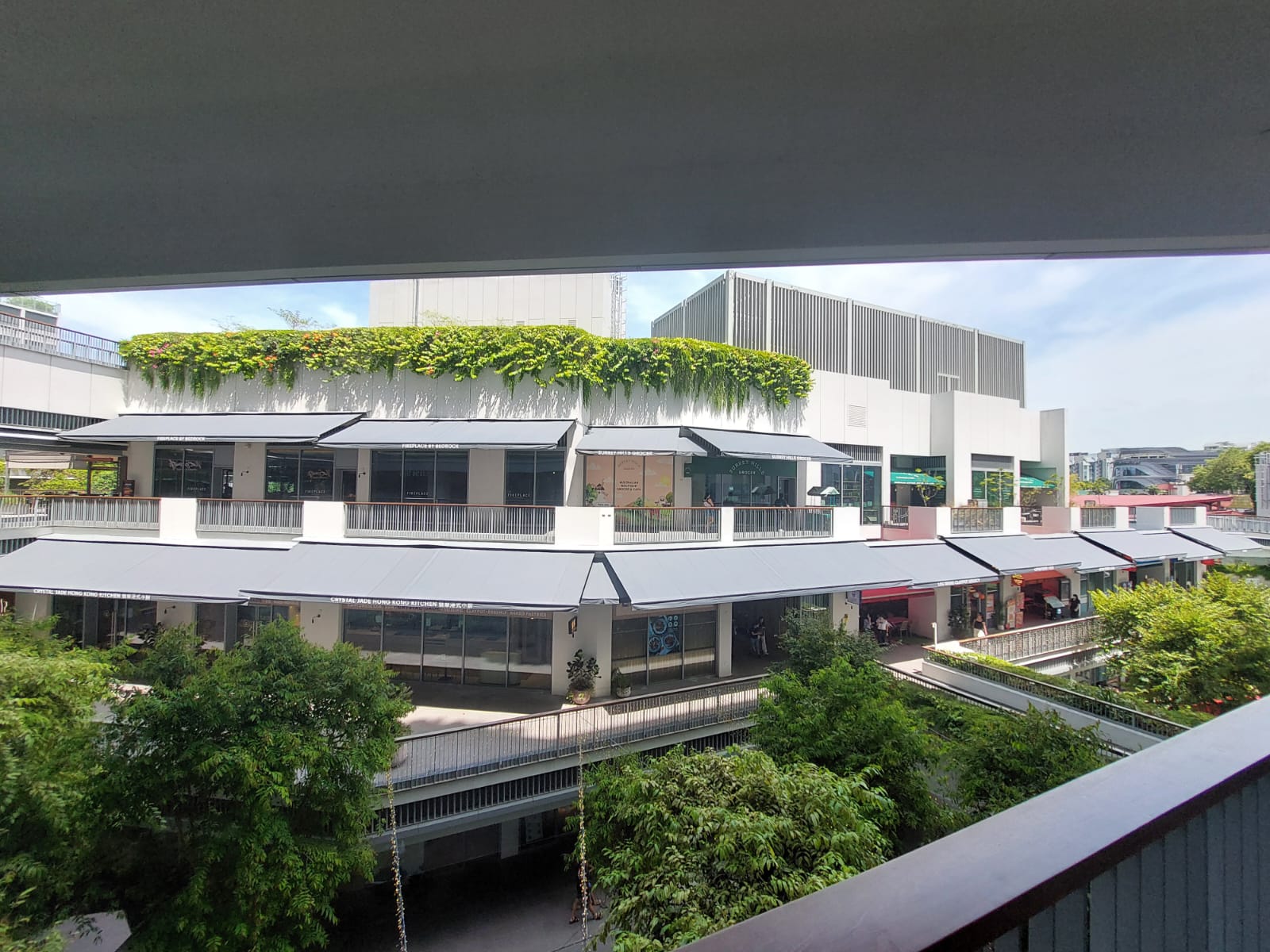
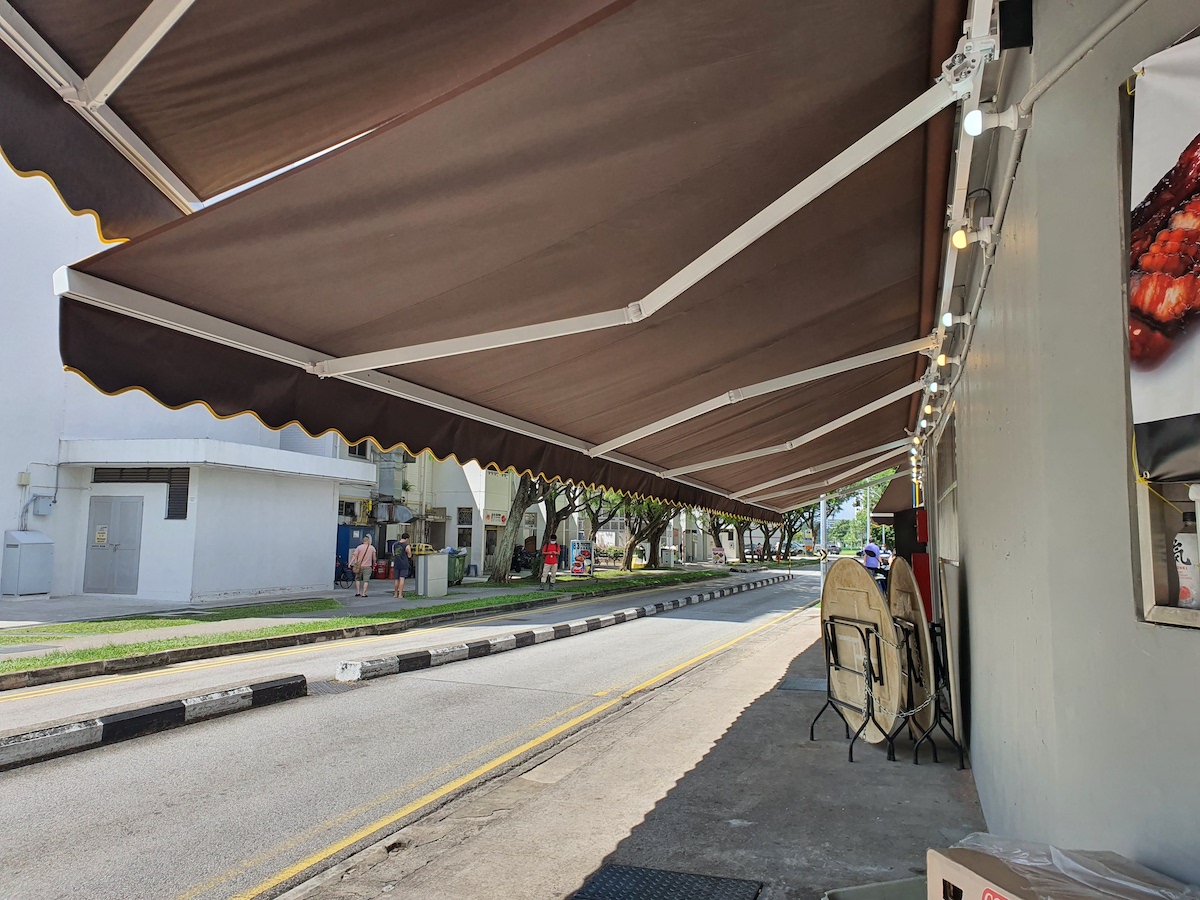
If you want the short answer, the motorised awnings that actually survive Singapore’s weather share four things. Solution-dyed acrylic fabric at 280 to 350 gsm. A full aluminium cassette that encloses the fabric when retracted. A Beaufort Class 3 wind rating (39 to 49 km/h) under European standard EN 13561. And a wireless wind sensor wired to retract the awning at 40 km/h gusts. Pair those with a quality tubular motor, a minimum 20 degree pitch for water runoff, and a powder-coated frame. Systems that hit this specification typically last 12 to 15 years here. Systems missing even one of the four tend to fail inside three.
Learn More: Motorised vs Manual Retractable Awnings: Which One Delivers Real Value?
Why Singapore rain is harder on awnings than most climates
Singapore sits 1.35 degrees north of the equator with a tropical rainforest climate (Köppen classification Af). The Meteorological Service Singapore records an average annual rainfall of 2,340 mm spread across all twelve months. Three factors drive the local awning specification:
- Sumatra squalls. These mesoscale convective systems develop over Sumatra and sweep across Singapore in the predawn and morning hours, usually lasting one to two hours. They bring heavy rain and gusts of 40 to 80 km/h. The highest recorded gust in Singapore, 144.4 km/h, hit Tengah on 25 April 1984 during a Sumatra squall.
- Northeast monsoon (December to March). Wind speeds sustain at 30 to 50 km/h over days. Sustained wind fatigues the arms and fabric faster than short squall gusts because the system cannot recover between loads.
- Relative humidity averaging 84 percent year round. Moisture trapped in rolled-up fabric creates the ideal environment for mildew, algae, and motor bearing corrosion. Any component that cannot tolerate continuous 80-plus percent humidity will fail early.
Any awning left extended during a squall is at real risk of fabric tearing, arm bending, or motor stall. Automatic retraction through a wind sensor is not a convenience feature in Singapore. It is what keeps the system working past year three.
The four specifications that actually matter
1. Fabric: solution-dyed acrylic at 280 to 350 gsm
Two fabric families dominate the local market: solution-dyed acrylic and PVC-coated polyester. They behave very differently in tropical conditions.
| Property | Solution-dyed acrylic | PVC-coated polyester | High-density polyester (480HDE) |
| Typical weight | 280 to 350 gsm | 450 to 600 gsm | 480 gsm |
| Waterproof rating | Water-resistant (shower-proof) | Fully waterproof | High hydrostatic head |
| UV colourfastness | Excellent, dyed through fibre | Moderate, surface coating | Good with UV topcoat |
| Breathability | Breathable, dries fast | Non-breathable, traps heat | Limited |
| Mildew resistance | High (acrylic plus anti-mildew treatment) | Moderate (traps moisture) | High with treatment |
| Typical Singapore lifespan | 10 to 15 years | 6 to 10 years | 8 to 12 years |
| Good fit for | Residential HDB and condo balconies | Commercial rainproofing where heat is secondary | Heavy-duty pergola roofs |
Solution-dyed acrylic at around 300 gsm is what Smart Awning specifies on most residential installs. The dye goes into the fibre rather than sitting on top of it, so equatorial UV does not fade the colour within five years the way it does with printed or coated fabrics. Smart Awning sources premium solution-dyed acrylic from established Italian, French, and US mills carrying a 10-year fabric warranty.
Where full waterproofing is non-negotiable, a flat-roof terrace used for dining during the northeast monsoon, for example, PVC-coated polyester or a 480 gsm high-density polyester with a hydrostatic head rating is the better choice. The trade-off is heat build-up underneath, because the coating blocks airflow.
2. Cassette: full aluminium, not open or semi
The cassette is the housing that encloses the fabric when the awning retracts. Three configurations exist.
- Open-face (no cassette). The fabric roll and arms sit exposed. Cheapest. Shortest fabric life in Singapore, typically 4 to 6 years before UV and mildew force a fabric replacement.
- Semi-cassette (hood only on top). The top of the roll is shielded but the underside stays exposed. Moderate protection, 7 to 9 year fabric life.
- Full cassette. An aluminium box fully encloses the fabric, roller, and folded arms. Protects against UV, airborne salt (which matters for coastal estates like East Coast, Pasir Ris, Sentosa Cove), wind-driven grit, and the daily rain cycles that otherwise deposit moisture onto rolled fabric. Typical fabric life 10 to 15 years.
Premium Singapore-market systems use an integrated cassette box with a gasket along the front bar that makes the closure watertight and silent. A typical full-cassette housing measures around 250 mm high by 185 mm deep and handles a single-section width up to 7 metres at a 4-metre projection. Wide-span systems extend to nearly 8 metres in a single section.
If you want the awning to last beyond seven years, full cassette is where the spec starts. Half-cassette and open-face designs trap moisture against fabric that rolled up wet, and here, the fabric rolls up wet most days.
3. Wind rating: EN 13561 Class 3 minimum (Beaufort force 6)
European standard EN 13561 classifies awnings by the wind strength they can handle while extended. It is the most useful specification for comparing models in Singapore because it cuts through marketing language and gives you a testable threshold.
| EN 13561 Class | Beaufort Force | Wind Speed | Singapore Fit |
| Class 0 | 1 to 3 (light air to gentle breeze) | Up to 19 km/h | Below minimum. Entry level only |
| Class 1 | 4 (moderate breeze) | 20 to 28 km/h | Too low. Fails in any squall |
| Class 2 | 5 (fresh breeze) | 29 to 38 km/h | OK for sheltered HDB balconies, marginal elsewhere |
| Class 3 | 6 (strong breeze) | 39 to 49 km/h | Minimum for exposed landed, high-floor condo, and rooftop installs |
No retractable awning is built to stay out through a full Sumatra squall at 80 km/h gusts. What a Class 3 rating buys is enough safety margin for the wind sensor to detect rising wind and retract the awning before the fabric tears or the arms bend. Standard flat-profile cassette systems on the Singapore market list a wind resistance of roughly 30 to 39 km/h (Class 2 to Class 3), while wide-span models tend to fall in the 21 to 29 km/h range (Class 1 to Class 2). For exposed Singapore installs, spec at the upper end or move up a class.
4. Wind and rain sensors: a wireless sensor pair with retraction override
A wind sensor that retracts the awning automatically is what keeps the install alive. A rain sensor that does the same overnight and when no one is home is what keeps the fabric from mildewing. Smart Awning specifies a wireless wind sensor paired with a solar-powered wireless rain sensor as the standard sensor configuration on motorised installs.
- Wireless wind sensor (battery-powered). Detects wind-generated arm movement and triggers retraction at a user-set threshold. Works with the standard wireless motor protocol.
- Wireless rain and sun sensor (solar-powered). Retracts the awning on rain detection and extends or retracts based on sun intensity. Useful for overnight protection when no one is home to operate the awning manually.
- Wireless outdoor sun sensor (solar-powered). Used for automatic shading cycles rather than weather protection.
Two sensor rules matter for Singapore. First, the wind sensor must have priority over every other control, including the handheld remote, the wall switch, the smart home app, and any schedule. If the threshold trips, the awning comes in. Second, set the threshold below the EN 13561 class rating with a safety margin. Typically 40 km/h for a Class 3 system. A sensor set to the class ceiling leaves no time for the retraction cycle to complete before damaging gusts arrive.
Motor selection: Smart Motor and premium tubular motor options
The motor is the component most likely to fail early if the spec is wrong. Smart Awning fits the in-house Smart Motor as the standard motorisation on its retractable awning range, with premium European tubular motors available as an option for clients who request them.
- Smart Motor (Smart Awning’s in-house tubular motor). Standard motorisation on Smart Awning retractable awnings. Carries a 2 to 5 year warranty depending on model. Compatible with the Smart wireless control system, Google Home, and Amazon Alexa.
- Premium European tubular motor (optional upgrade). Italian and French manufacturers offer 5-year warranty motors with similar torque and noise profiles. Available on request at higher cost; specify at the quote stage.
Quality tubular motors in this class publish noise ratings under 44 dB and support obstacle detection that stops the motor if an arm hits something during extension. Smart Motor units are sized to handle the torque demand of standard residential awnings up to 7 metres wide.
On a Singapore install, the motor itself is rarely the limiting factor. What matters more is that the installer wires the sensor signal into the motor logic correctly, so sensor retraction overrides every other command. Ask the installer to demonstrate this during handover.
Pitch: minimum 20 degrees for water runoff
Pitch is the angle of the extended awning relative to horizontal. A shallow pitch causes water to pool between the arms, which forces the fabric to stretch under weight and eventually tears the stitching or pulls the front bar loose. Standard full-cassette systems specify a 20-degree minimum pitch for clean runoff. Some references list 14 degrees as the absolute minimum. 20 degrees is the working number for Singapore’s rainfall intensity.
Pitch is one of the details the installer has to take into account during the wall survey. On a balcony with limited vertical clearance, a 20-degree minimum pitch sets a hard ceiling on projection. The further the awning extends, the lower the front bar drops. This is one of several reasons a proper pre-install site survey is not optional.
What to ignore in the brochure
A typical sales brochure lists ten to fifteen features. Only the four specifications above actually affect long-term performance in Singapore. The rest is nice to have, but it does not drive performance:
- LED arm lighting. Aesthetic. Adds cost. Draws no meaningful power. Does not extend fabric life.
- Drop valances. Useful for privacy in specific layouts, not a weather or longevity factor.
- App dashboards with usage statistics. Convenience. The sensor behaviour is what protects the system.
- Custom fabric colour match. Aesthetic. Solution-dyed acrylic is UV-stable in any colour from a reputable mill.
- Frame colour options. White, anthracite, and grey are the three standard colours across the market. Any brand offers them.
Ignore those, focus on the four specifications, and a ten-brochure comparison narrows down to two or three models that actually fit the site.
Comparison snapshot: three systems typical of the Singapore market
| Spec | Premium full-cassette system A | Flat-profile cassette system B | Wide-span cassette system C | |
| Cassette type | Full integrated (watertight gasket) | Full (flat profile) | Full or semi | |
| Max width | 7.0 m single section | 7.0 m | 7.9 m | |
| Max projection | 4.1 m | 3.6 m | 4.3 m | |
| Motor | Smart wired only | Smart (motorised only) | Smart (motor or manual) | |
| Wind rating (published) | Class 2 to 3 depending on model size | 30 to 39 km/h (Class 2 to 3) | 21 to 29 km/h (Class 1 to 2) | |
| Fabric | Premium Italian acrylic (10-yr warranty) | Acrylic, 500+ patterns | Acrylic, 500+ patterns | |
| Frame colours | White, Corten, Anthracite | White, Charcoal, Grey | White, Brown, Sand, Charcoal, Jet Black | |
| Warranty | Limited lifetime frame, 10-yr fabric | Limited lifetime frame | Limited lifetime frame |
Use this as a template for any vendor comparison. Fill in the same six rows for each quote and the performance gap becomes obvious.
Alternative: motorised vertical screens for extreme weather sites
Standard retractable awnings handle light to moderate rain. Sites with persistent driving rain, an upper-floor balcony facing the northeast monsoon direction without any building shelter for example, benefit from pairing an overhead retractable awning with a motorised vertical zip screen. Premium zip-screen systems for this application are rated to wind speeds up to 120 km/h and use zipped track edges that keep the screen tensioned even in a squall. They handle the side protection the overhead awning cannot and retract fully when not in use.
For the full zip screen buyer’s guide, see the Outdoor Zip Blinds in Singapore piece in the Automated Balcony Blinds pillar.
Installation and permit context
Even a perfectly specified awning underperforms if the wall substrate cannot carry the load, or if the installation gets blocked by the town council or MCST. For a 4-metre projection awning in Class 3 wind conditions, anchor loads reach around 2.5 kN per fixing, which means solid reinforced concrete or properly rated masonry anchors. HDB flats, ECs, and private condos each follow a different approval route.
- HDB flats. Town council approval is required for any external installation visible from the common corridor. The submission needs a technical drawing, anchor specification, and wind load calculation.
- Condominiums (MCST managed). The MCST approves external works against building by-laws. Facade uniformity and external colour scheme are often governed.
- Landed homes. URA planning permission is required if the awning changes the external elevation beyond the approved envelope. BCA approval covers structural adequacy for anything attached to the building facade.
For the full approval walkthrough with timelines and document checklists, see Awning Installation in Singapore: Permits, Timelines, and What to Expect.
Maintenance that keeps the system at full performance
Three maintenance rules extend a Singapore awning’s life from the default 10 years toward the 15-year end of the range:
- Never retract the awning wet for prolonged storage. After rain, extend the fabric and allow at least 30 minutes of dry time before rolling back into the cassette. Mildew becomes visible within 72 hours on rolled-wet fabric.
- Clean the fabric twice a year with a soft brush and a pH-neutral detergent diluted 1:20 with water. Acid-based and alkaline cleaners strip the acrylic’s dye fastness.
- Service the motor and arms annually. The service should include arm torque check, gasket inspection on full cassettes, and sensor battery replacement for wireless sensor units.
The full maintenance routine is in Motorised Awning Maintenance Tips for Singapore’s Year-Round Humidity.
Working with Smart Awning
Smart Awning supplies motorised retractable awnings specified for Singapore’s climate. Smart Awning is a popular choice for homeowners and businesses in Singapore because they act as a direct contractor, offering high-quality materials and professional installation at competitive prices. Every quote includes a site survey that covers wall substrate, mounting geometry, wind exposure, and sensor placement. Standard specifications run to European-grade full cassettes, premium solution-dyed acrylic fabric, the in-house Smart Motor with a 2 to 5 year warranty, and a wireless wind sensor calibrated to the site’s exposure. The Smart system is compatible with Google Home and Amazon Alexa for voice control and scheduling.
The service area covers HDB flats, condominiums, landed properties, and commercial storefronts across Singapore. Installation teams handle town council, MCST, and BCA submissions as part of the project scope.
Frequently asked questions
What are the best motorised awnings for tropical rain in Singapore?
The best motorised awnings for tropical rain in Singapore share four specifications: solution-dyed acrylic fabric at 280 to 350 gsm, a full aluminium cassette that fully encloses the fabric when retracted, an EN 13561 Class 3 wind rating (39 to 49 km/h), and a wireless wind sensor wired with override priority that retracts the awning at 40 km/h gusts. Smart Awning specifies all four as standard on its motorised retractable range, fitted with the in-house Smart Motor and a Google Home / Amazon Alexa compatible Smart control system.
The best motorised awnings for Singapore’s tropical rain are full-cassette folding-arm systems spec’d with four features: solution-dyed acrylic fabric at 280 to 350 gsm (Tempotest, Dickson, or Sunbrella), EN 13561 Class 3 wind rating (39 to 49 km/h), a tubular motor with a 5-year warranty, and set to retract at 40 km/h gusts with priority over every other control.
Which are the top-rated smart awnings with wind sensors?
Top-rated smart awning setups in Singapore pair a full-cassette retractable system with a wireless wind sensor and a wireless rain sensor for overnight protection. The wind sensor is battery-powered, wireless, and triggers retraction at a user-set wind threshold. The rain sensor is solar-powered and retracts the awning when rain is detected. Smart Awning bundles this sensor pair with its Smart Motor and Smart control system, giving compatibility with Google Home and Amazon Alexa for voice control and scheduling.
Can a motorised awning handle Singapore monsoon winds?
A motorised awning spec’d at EN 13561 Class 3 can stay extended in sustained winds up to 49 km/h. Beyond that threshold, no retractable awning is built to stay open. The system relies on the wind sensor to retract automatically before damaging gusts arrive. For Sumatra squalls, which gust to 80 km/h within minutes, a Class 3 rating combined with a 40 km/h wind sensor trigger gives roughly two to three minutes of retraction time before the worst of the gust hits.
What fabric lasts longest on a Singapore awning?
Solution-dyed acrylic at 300 gsm lasts longest on a Singapore residential awning, typically 10 to 15 years in a full-cassette system. The dye penetrates the fibre rather than coating the surface, so equatorial UV does not fade the colour prematurely. For commercial or heavy-duty pergola applications where full waterproofing is required, 480 gsm high-density polyester (480HDE) with an acrylic or PVDF topcoat is the longer-lasting choice.
Is a full cassette worth the extra cost in Singapore?
Yes. A full cassette adds roughly 15 to 25 percent to the frame cost and extends fabric life by three to five years in Singapore conditions. The cassette protects rolled fabric from UV, airborne salt, wind-driven grit, and the moisture that otherwise accumulates on fabric that rolled up wet. Given fabric replacement on a standard 4-metre awning runs SGD 1,800 to 3,000 installed, the cassette pays for itself before the first fabric replacement cycle.
How long does a motorised awning last in Singapore?
A correctly specified motorised awning lasts 12 to 15 years in Singapore. The motor typically carries a 5-year manufacturer warranty and lasts 8 to 12 years in field use. Fabric lasts 10 to 15 years in a full cassette, 6 to 10 years in a semi-cassette or open-face system. The aluminium frame carries a limited lifetime warranty on most premium brands and outlasts the motor and fabric by a wide margin.
Which motor brand should I specify: Somfy or Nice?
Both are acceptable. Somfy has the larger installed base in Singapore and the broader sensor and smart-home ecosystem. Nice offers comparable mechanical quality and competitive pricing. If smart-home integration is a priority, Somfy’s TaHoma gateway has wider native compatibility in the Singapore market. If budget is the deciding factor, the Nice Era series typically comes in 10 to 15 percent below the Somfy equivalent.
How does Smart Motor compare to premium European tubular motors on cost and warranty?
Smart Motor is Smart Awning’s in-house tubular motor designed for the Singapore market. It carries a 2 to 5 year warranty depending on model and is the standard fitment on Smart Awning’s retractable awning range. Premium European tubular motors are offered as an upgrade with extended warranty terms.
The short version
The best motorised awning for Singapore’s tropical rain is defined by specification, not brand. Solution-dyed acrylic at 300 gsm, a full aluminium cassette, an EN 13561 Class 3 wind rating, and a wireless wind sensor with override priority. A system missing one of these four fails early. A system with all four lasts 12 to 15 years and handles every weather condition Singapore throws at it short of a full Sumatra squall, at which point the sensor takes it in automatically.
